Evidence is what separates doctors from palm readers but there are caveats

Andrew Foy had an important post last week over at Sensible Medicine. He told the story of spironolactone in heart failure. I often cite the RALES trial of spironolactone vs placebo as one cardiology’s biggest effect sizes. The absolute reduction in death was a whopping 11%. The inexpensive mild diuretic had an NNT to save a life of just 9.
Yet spironolactone is not an easy drug to use. You have to get labs after starting it because it can cause high potassium levels, especially in patients with impaired kidney function or those taking ACE-I or ARB drugs. Both of these are common in patients with HF. In fact, whenever I write for spironolactone the EMR gives me a drug-drug interaction alert.
Foy smartly cited an observational study from Ontario published soon after RALES that showed that spironolactone use increased after RALES but so did potassium related complications. Crucially, the Canadian authors found no evidence that the extra spironolactone reduced heart failure hospitalizations.
Vinay wrote an adjoiner calling this an efficacy-effectiveness gap. Here is a slide I often show to learners.
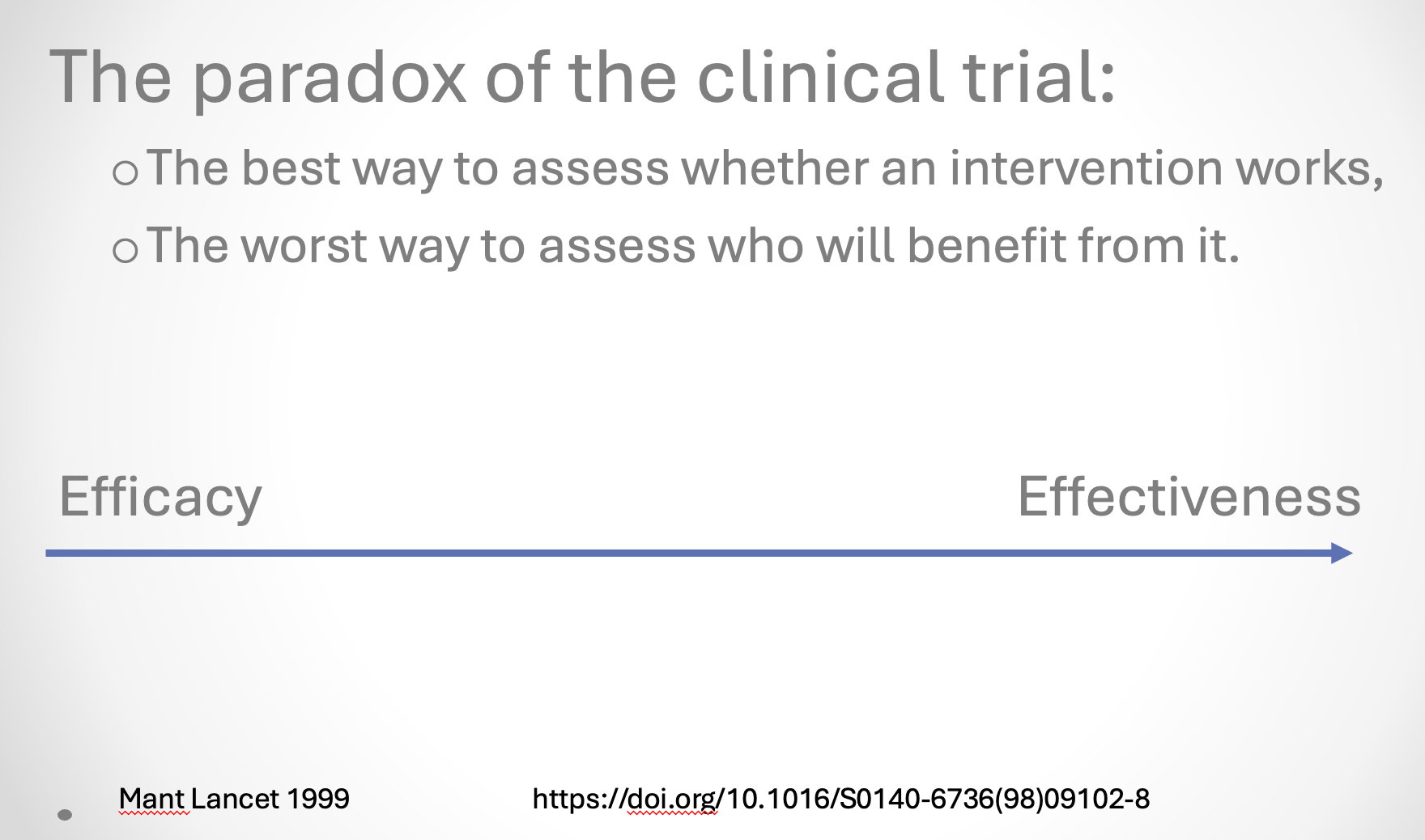
Trials, it turns out, are the best way to test whether an intervention works (efficacy) but the worst way to assess who will benefit from it (effectiveness).
Foy and Vinay both point out that trials do two things that are not done in the real world: a) they select patients in whom the intervention has the best chance to work and b) trial procedures provide hypervigilant protection of patients.
Vinay points out that oncology trials recruit patients with good functional status and strong family support. I can vouch for this firsthand. We are a recruiting center in the Left vs Left trial of conduction system pacing vs biventricular pacing in patients with an indication for cardiac resynchronization therapy. Basically two ways to achieve CRT. Trial inclusion and exclusion criteria are strict, but that’s rarely the barrier. The barriers are whether the patient has the support, strength, cognitive ability or desire to participate in the trial. We exclude many patients because the trial won’t work for them.
Recruiting the best patients is one thing, but trial procedures are equally important. In RALES, for instance, Foy tells us that patients had numerous lab checks; many more than is routinely done or feasible in regular practice. He doesn’t say this but you should know that being in a trial is wonderful because not only do you have doctors but you also have an uber-detail-oriented research nurse who makes sure nothing falls through the cracks. Research nurses are like healthcare guardian angels. There are no research nurses in regular practice.
RALES is not an outlier when it comes to extraordinary procedures. The seminal beta-blocker trials that established these drugs in the post-MI setting had incredibly unrealistic monitoring. Read about the monitoring in the 1982 BHAT trial over at Cardiology Trials substack.
Nothing about selection of patients or trial procedures are nefarious. Rather it is an attempt to enhance efficacy. Does the drug or procedure work in this ideal environment?
Our job as clinicians is to figure out whether benefits seen in the trial environment can be duplicated in the patient in front of us. Clinicians need to focus on effectiveness.
Foy has some great rules:
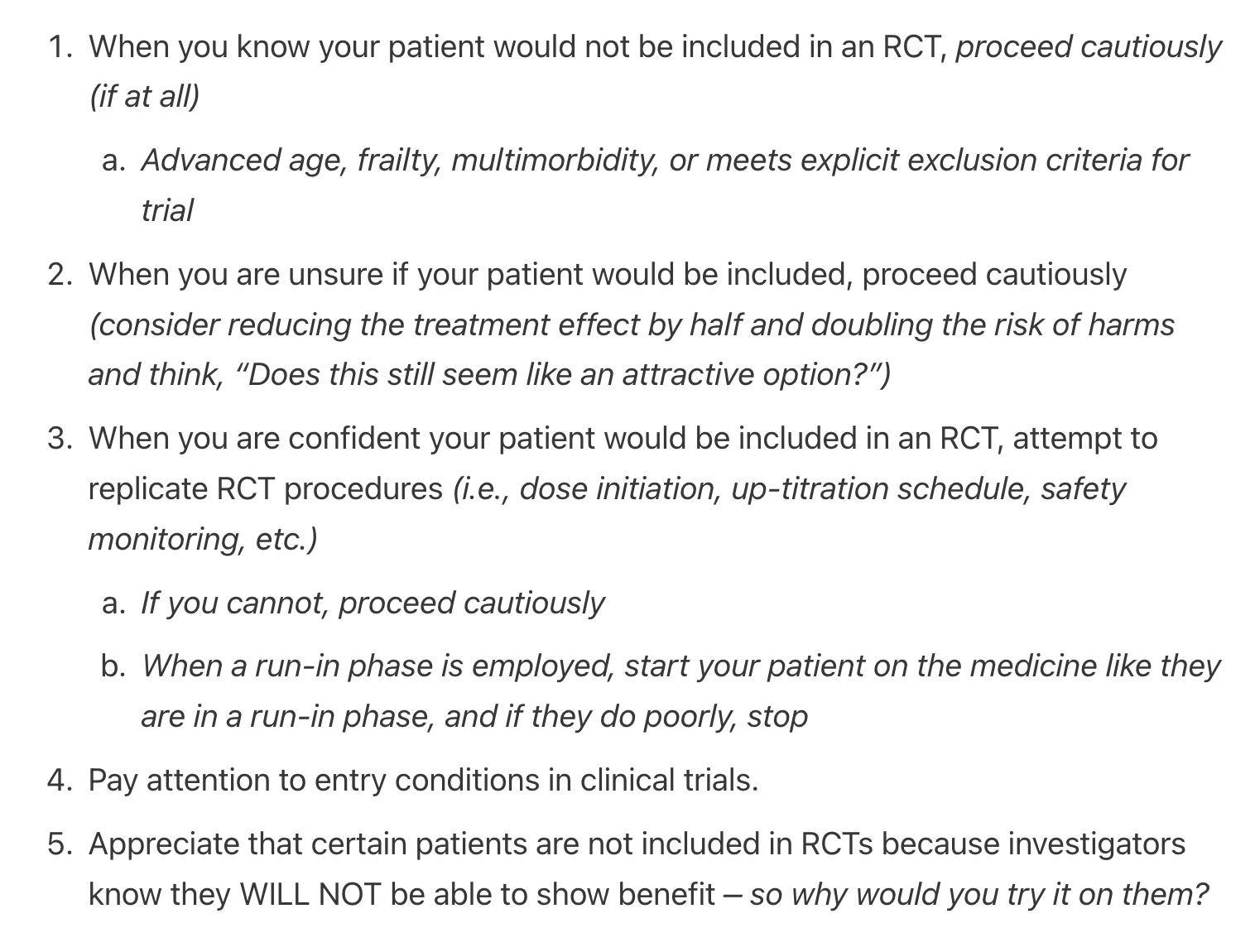
I love these rules. They should be taught in every medical school and residency program.
Here is the problem though: doctors who apply these rules will use less of the anointed therapies. They face the tension of EBM enthusiasts who push things like “guideline directed medical therapy,” which sounds great in practice but can create mischief for many patients.
When I discharge a 90-year-old with a walker with tennis balls on it and severe kidney disease, the EMR tells me I am not using proper GDMT of her chronic HF. The average age of patients in the HF trials—mid 60s.
How or why, you wonder, could following GDMT become a tension or problem?
No field is more emblematic of the tension between Foy’s rules and guideline-mandated care than the treatment of patients with heart failure. The seminal trials of heart failure drugs were performed sequentially. ACE-I were first; then the beta-blocker trials tested adding on beta-blockers. In RALES, patients were on ACE-I and spironolactone was tested as an add-on. In the SGLT2i trials, patients were on the three drug classes. All of this was sequential. Most were done in stable ambulatory outpatients.
But now there is a strong push to start all these drugs at once and early, often in the hospital. Proponents cite observational studies showing that patients started on four drug classes right away do better. But these studies are flawed by huge doses of selection bias; of course a patient who can tolerate 4 new pills is more robust than those in whom a doctor would never attempt such an aggressive move.
Vinay rightly points out that a proper trial would test the theory that rapid sudden initiation of 4 drugs is superior to a sequential slow approach. This is the best way forward.
HF leaders worry that not starting drugs early and all at once risks undertreatment. This is a reasonable concern as inertia is clearly a barrier to the best medical care. I have seen both.
Yet I favor Foy’s approach.
Use of medical evidence is absolutely necessary. Otherwise we are like palm readers.
But efficacy in a trial is a lot different than effectiveness in the real world. The best doctors understand this. They are the doctors who I would want to care for me.
But they may not be the doctors with the best EBM scorecard.
John, I'm sure you misspoke.
"Nothing about selection of patients or trial procedures are nefarious".
Truth is that everything about patient selection and trial procedures IS nefarious, if conducted or supported by Big Pharma. The "C" suite spends millions to design and conduct trials that have been predetermined to make their particular drug look amazing. And if per chance the trial did not achieve their nefarious goals, they will burry the data and never report it. Having worked on the other side for many years, I can vouch for this. Bogus studies equal big profits. Most doctors are naive and believe Big Pharma is operating in the best interest of their patients. That is why they get away with this egregious behavior. Thanks for pointing out inconsistencies and helping us evaluate what is real and what is hype.
A recent good illustration of the efficacy-effectiveness gap is Paxlovid (nirmatrelvir/ritonavir). The trial used for the initial approval enrolled relatively young and healthy subjects with no evidence of prior illness or vaccination. The enrollment period was mainly during the delta wave of covid, with just a short period as omicron was taking over the pandemic. Reminder: delta caused rather more serious illness compared to omicron. Even with these cherry-picked patients, the treatment effect was modest, and crucially for a germ that no longer existed. Paxlovid has many drug-drug interactions, making it a challenge to use.
I never prescribed Paxlovid because there were no real-world patients who met the conditions of enrollment in the efficacy trial.